
Insights / 02
A point cloud is a photograph. A mesh is a tool.
Capture vendors love to show you a beautiful point cloud. It looks like your plant, and it is nearly useless for planning work. The difference between a picture of an asset and a model of one is the whole game.
What a point cloud actually is
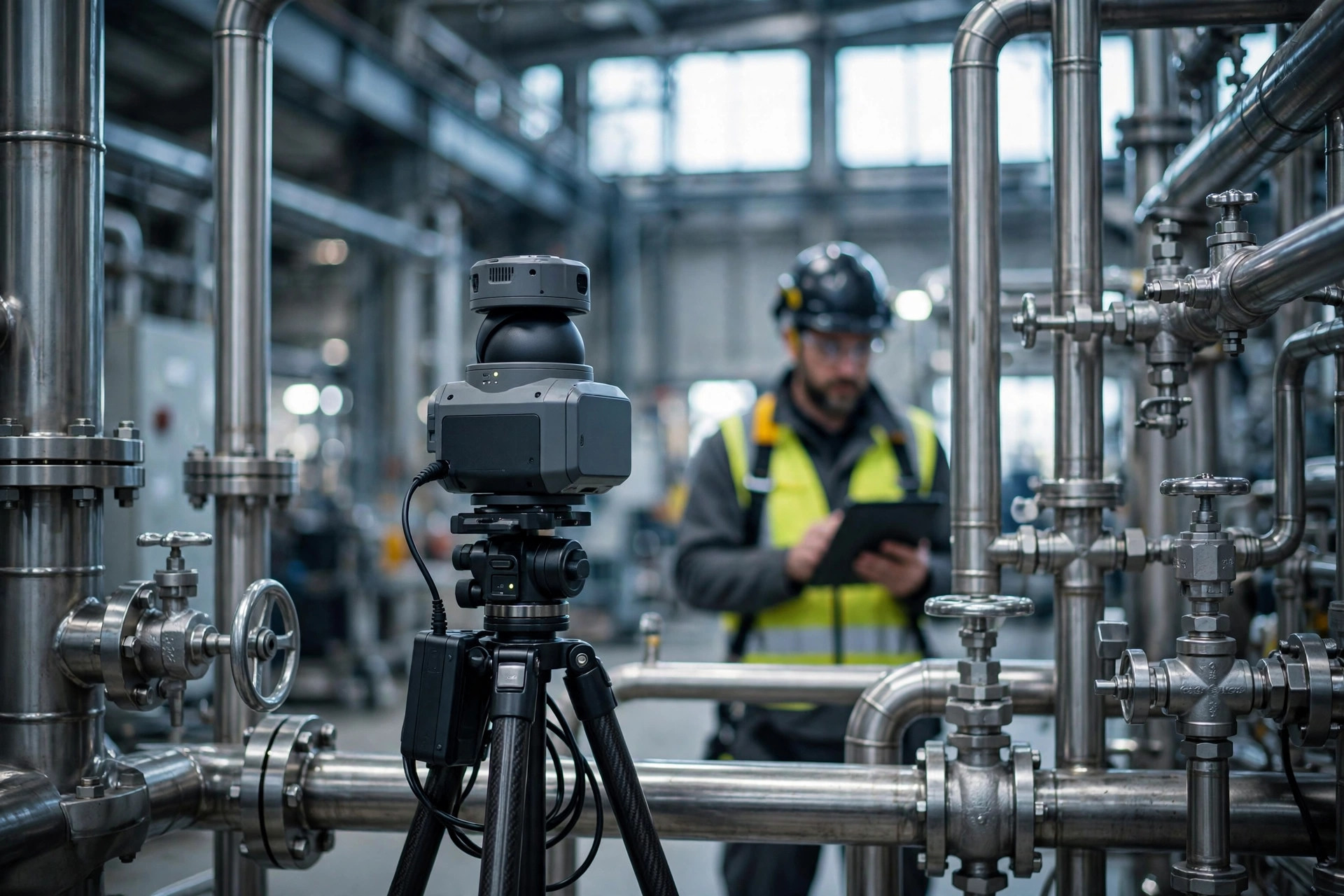
A point cloud is millions of measured dots in space: the output of a laser scanner or a photogrammetry pass. It is superb evidence of geometry at a moment in time. It is also inert. A dot has no name, no history, no idea it belongs to a pump. You cannot move a point cloud's compressor to check a lift path, delete its scaffolding, or ask it what changed since March.
What an editable mesh adds
Meshing converts the cloud into surfaces, and segmentation carves those surfaces into objects: this vessel, that exchanger, this run of pipe. Once an asset is an object, work becomes possible. Cut it, move it, duplicate it, clash it against a planned install, animate a relocation path, measure clearances against the as-built instead of the as-designed. This is the layer the geometry leaders sell, and they sell it well: browser viewers, zones, asset carving, layout planning, CAD overlay and clash checks are real, proven capabilities in the market today.
We say this plainly because pretending otherwise helps nobody: geometry editing is a solved product category, and our own build order treats it with respect.
Where the twin actually lives
Here is what a mesh cannot do. A mesh does not know that the exchanger was cleaned in the 2024 event, that its gaskets are the failure mode, that its custody readings feed a settlement, or that yesterday's branch modeled its replacement. A mesh is geometry. A twin is geometry plus state plus evidence plus time.
Our platform's strength today is exactly that second half: a versioned state model of records, versions, branches, releases and measurements, a knowledge layer of systems, components, failure modes and maintenance procedures, signed custody evidence through OkariGX, and settlement through XODIAK. Mesh generation and per-object segmentation sit at the top of our twin build order, feeding objects into a state model that already exists, instead of into a viewer that forgets.
The buyer's rule
Buy pictures and you will re-buy them every event. Buy a twin and every capture makes the record richer. Geometry is the entry ticket. State is the asset.
Field facts
- Point cloud
- Measured dots. Evidence of shape at a moment. No objects, no history.
- Editable mesh
- Surfaces carved into named objects. Movable, measurable, clash-checkable.
- Twin
- Geometry plus versioned state, knowledge, evidence and settlement.
- Our build order
- Mesh generation and object segmentation first, bound to the state model that already runs.
Keep reading
Start / One door
Bring us an asset.
A plant, a terminal, a building, a venue. If it exists in the world, it belongs in the system. Tell us what you operate and we will show you the twin.
Start a conversation